7/1/2026 9:00:00 AM | General
A wide range of topics coverage discussed in annual report
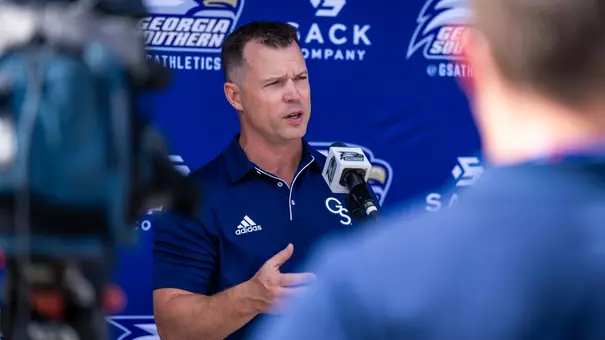
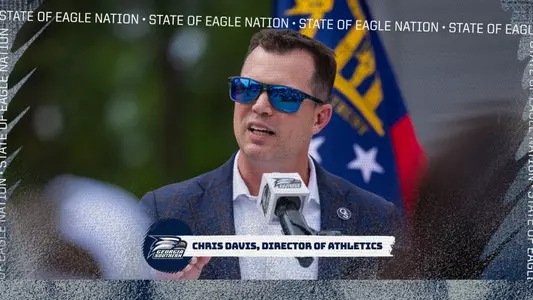
STATESBORO — As the 2025–26 athletic and fiscal years come to a close, GSEagles.com sat down with Director of Athletics Chris Davis to reflect on his first two years at the helm and discuss what's ahead for Georgia Southern Athletics.
Q: As we conclude the 2025-2026 athletics season and now that you're two years in, how does a Chris Davis athletic department look in this modern age of college athletics?
CD: We still have to keep the main thing the main thing, which is taking care of our student-athletes, our coaches, our staff, our donors, fans and alumni, and representing Georgia Southern University at the highest.
I think that's something that sometimes gets lost in today's modern age. But that's still a critical part. I'm proud of a lot of things we do because, at the end of the day, we are people-focused. And if you think about it, our donors, our fans, and our alums: people. Our student-athletes are the epicenter of everything we do in athletics: our focus. Our coaches, who spend the most time with our athletes, are very important to our enterprise: our focus. Our staff, and everything they do to put on all our different games and events. All the care they put into meeting our fans, donors, and alumni, and into communicating: our focus. Representing an incredible institution like Georgia Southern and working with Dr. Marrero, an incredible president, and our cabinet-level leadership, and everyone at this institution: people. So at the end of the day, our focus is on people.
And then strategy. I think it's people-focused with strategy. We are very much looking at every ounce of strategy and getting more and more focused on what that means and looks like in this ever-changing landscape. From a strategy standpoint, you're seeing it across the board in everything we're doing.
It's not just facilities now; we're looking at how to build rosters. How is that really important in today's landscape? That's a piece. How do we support our coaches and staff individually while still recognizing it's a comprehensive enterprise? It's more of an individualistic approach because the way we approach helping one sport compete versus another is definitely different. The business aspect of college athletics in terms of planning and running budgets is more complex than it has ever been. We've been able to grow our budget while also landing on budget for that fiscal year, which is something I'm really proud of. We're projected to grow our budget for this upcoming year, which is something that helps every area of our department.
The complexity of college athletics leads to the need for a more robust strategy. It's not a one-size-fits-all approach at Georgia Southern Athletics; it's tailored to each sport. It's planning and executing a budget to help all 17 of our sports and departments while staying fiscally responsible.
Knowing that, at the end of the day, the entity of Georgia Southern Athletics needs to represent Georgia Southern University as a whole and also make our alumni, our fans and our donors proud. And that's a heavy lift, but it's extremely important that we do that.
Q: There's a lot of talk in the business about revenue generation, fan experience and storytelling. How is the department pivoting to this style of external communications?
CD: It's definitely different because you need to give a lot of information, and that information is changing. There's a lot of information out there from a national perspective that people are reading on social media and other sources. Not that it's untrue, but what does it mean for Georgia Southern when there are a lot of people taking a stance on something when no one really knows what's actually going to happen? I'm very big on making sure we do keep the main thing the main thing. When we talk about facts, we can talk about facts. We stay in an area where we can change on a dime. Georgia Southern Athletics is striving every day to drive greater resources and we can pivot quickly because we have great people and the ability to execute a strategy.
Now, the key is what is best for Georgia Southern? And in the revenue generation category, we're looking at all kinds of different things for Georgia Southern. There's the Eagle Victory Plan and looking at how that rolls out, and the five different buckets we've talked about. Terry Harvin has done a lot of his own videos, which is important. Terry is an important part of our athletics foundation, and our foundation is a vital cornerstone to everything we do. Raising money is important; raising money in all those different buckets is important. Meeting people where they are and explaining what that means and how to do it, is important. So it's really taking the time to be focused while also getting out with people and talking with them. But it's important to make an in-person touchpoint; it's a phone touchpoint; it's a digital touchpoint through emails, social media, websites and press releases. How we tell those stories – all of those touchpoints matter - but I put more focus on the people piece because that's where I stand, but we still have to do all the different channels. That's why when I go to an athletic event, whether we're winning or losing, I am always walking around. I think that's important because we always need to be accessible.
Storytelling is going to be at the top of our list this upcoming year, not just by me but by our entire athletic department. Georgia Southern University is a brand, and the old adage is that athletics is the front porch. We have to go and get even deeper with our storytelling. That's something that we're challenging our entire team on. How can we become even deeper storytellers, and that's in every medium? That's the key. We can't just put a video out on social media. What does a short video look like? What does a YouTube video look like? Outside of social media, do we release a video in an email? Is it all just digital? Storytelling is also in-person. How many in-person events do we do? I may know the information, but I have to do a great job cascading the info all the way through, so all our foundation people, or somebody in the ticket office, they know a piece of the story. It's just not a data piece; it's a storytelling piece.
We're really big on that. We're a brand, and what do the best brands do? They talk, and they communicate; they story tell as well as execute. So we have to execute; there's no doubt, but we also have to tell the stories that show the past, present and future growth of this great department.
Q: Some schools are getting sponsors for patches on jerseys and trying new fundraising initiatives. Are there any other interesting ideas for revenue in the fold?
CD: We are constantly looking at different and unique ideas. Yes, we are in the game of the jersey patch – putting that in front of different people. We are big on making sure we drive the correct value; whether we take a yes or no, the bottom line is we need to get the right value. Once you put that partnership together, it probably will happen for a while. We did a great job when the NCAA allowed us to put logos on the field. We were fast in adopting that. Credit to the Sack Company and the Georgia Southern Sports Properties team, as we were one of the first schools to take advantage of that. We are in the same realm on the patch.
We will stay innovative like we always have been. There are a lot of premium options out there at our venues. So we are tweaking how we execute some things on the premium side. We are also looking for more opportunities for fan interactive zones, like right as you walk into Paulson Stadium. We did some unique things at our women's basketball game versus LSU and used that as a trial run for the future. We're looking at the game atmosphere. If people are having fun outside of watching the game, we have to be able to do it across the board. People are taking time to attend our sporting events, and it's important to be competitive in that environment. We have to do a good job of making sure it's entertaining all around. Look at what we're doing with Erk Russell's 100th birthday this year. That is a neat thing to bring to life. Because Erk impacted this institution, athletic department and football program, and really was the cornerstone of a lot of our founding values. Do Right. GATA. Have that be a storytelling piece and really have fun with it, both as a fanbase and as an athletic department.
Q: What are your thoughts on the newly passed age-based eligibility model?
CD: There's a lot of information out there in college athletics about all the changes coming down the pike. On the new age-based eligibility model, specifically, I support it. I think it cleans up a lot. I like the ability for students to navigate the portal and financials. But there are things in there we need to stabilize. The new model cleans up a lot.
Coaches, student-athletes, and anyone who wants to compete in life - everyone wants to know the rules of the game, and then let me go play. If I win, I won. If I lose, I lost and want to get better for the next game. What I think is irritating a lot of people in the industry and penetrating the fanbase is that the rules are changing. It's hard to stabilize when you don't know what the rules are or when they're changing. We have to get to a point where it cleans it up.
There's also the Protect College Sports Act going through the channels in D.C., which has several parts that I like in terms of a transfer process. I like that it's proposed that a student-athlete can transfer once as an undergrad, but if they transfer a second time, the old rules go into effect in terms of sitting out a year. But if you get your undergrad degree and still have eligibility left and want to get your master's, then you can do a grad transfer if you want. That's where I stand on these models, and I think they will benefit us as Georgia Southern, but also benefit us as an industry.
Q: From a Georgia Southern and Sun Belt perspective, what are your thoughts on potential CFP expansion?
CD: For the College Football Playoff, I have both global views and views just for Georgia Southern. Speaking specifically from Georgia Southern's perspective, I think access comes first. Can we make sure the G6 has access to the CFP? We do. It was awesome for a Sun Belt team to represent the conference last year. To have that access point is very important. If we go to 16 or 24 teams, or stay at 12, right now the focus is on where we sit at Georgia Southern, making sure we have access to it.
When you look across the board, and you look at how many schools are trying to get into spots, I think the number getting larger than 12 is definitely the way to go. One day I think it's 16, one day I think it's 24. When you think of how many schools are trying to get there, it makes sense. But what's really important for people to understand in football, if we go to Week 0 and that becomes a game week, it allows you to bump up the schedule a little earlier. But now we have to slide the schedule earlier so you have time to play more games. There are a lot of conversations around the overall football calendar as it relates to games, practices and recruiting that all impact our annual football calendar that need to be addressed.
I think it's good for the game and good for our entire enterprise. College sports consumption is at an all-time high. College sports are going through a massive state of change. But the one thing is, we have to have a consistent voice in making decisions. We may not have all the answers, but we need a consistent voice. Not letting emotions make decisions, but allowing data and thoughts, cross-pollination of thoughts, and then emotion to dial in what that answer is.
Q: Fans hear terms like revenue sharing, NIL and roster management every day now. For Eagle Nation, what's the biggest misconception about how all of this impacts a program like Georgia Southern?
CD: First of all, the portal, NIL and revenue sharing are here, and they're here to stay. There are great things and not-so-great things about the portal as it affects our rosters. I understand when a fan or donor gets upset about a player leaving; it makes sense. The important part is this: from a portal standpoint, we need to focus on each individualized sport and what's important to how we build the rosters. We have tools that the coaches use to navigate their rosters so they know who they have, where their vacancies are and a management for the overall roster building.
We want to do everything we can to drive resources in the revenue sharing area because it helps us compete at a greater level. Our resources and matching fan expectations are what keep me up at night. I genuinely care that our student-athletes can compete at the highest level, and our coaches can do what they need to put the best team they can. Our fans, donors and alumni want us to have a winning product that they can be proud of. So, how can we get them there from the standpoint of getting more wins? Money doesn't buy championships, but when you have the right financial stability with the right people/connections and the right integrations of those two, you can do some magical things. We need to have more intentional conversations than ever with our coaches about who can best integrate into the roster. Combining high school and portal recruits, and putting all those pieces together to make a connection to compete is vital.
Q: Four Eagle teams made the postseason this year. Looking back, what accomplishments across the department make you the most proud?
CD: Degrees from this University matter from the standpoint that no one can take that away from you. From the student-athlete piece, we sometimes don't talk enough about it. We graduated a bunch of student-athletes this year. Ryan Gilbert and his team did a phenomenal job, and we finished with a record GPA of 3.264. It's really impressive when you think of nearly 400 student-athletes with that GPA.
Our fall sports were a lot of fun, and we had a lot of successful moments. Our men's soccer program was nationally ranked with a high RPI, and we had two players taken in the MLS rosters. How cool is that? They were homegrown by Coach Squires and his staff. We had an incredible gift from Bo Pitts that impacted the whole team, and you saw how that changed things. We matched people and revenue. We had the financial resources and the right people and created some really cool things.
Look at volleyball and what Chad Willis has done and continues to do with that program. I know he's chasing the Sun Belt championship. There has been a lot of magic in Hanner, and there's only more to come.
Football had a very impactful season because it had multiple chapters. The West Coast chapter was really tough, and then we had a tough time in October, but we came back and had a strong November that led into a strong bowl performance and win in Birmingham. Yes, we want November to be where we chase conference championships, and we can't shy away from that. It's really important. That's why we're focused on making that even better for next year. Coach Helton's roster building and staff building is vitally important. We took a deep look at everything we could to continue to up that support as a cornerstone of who we are at Georgia Southern, and we need to continue to do that.
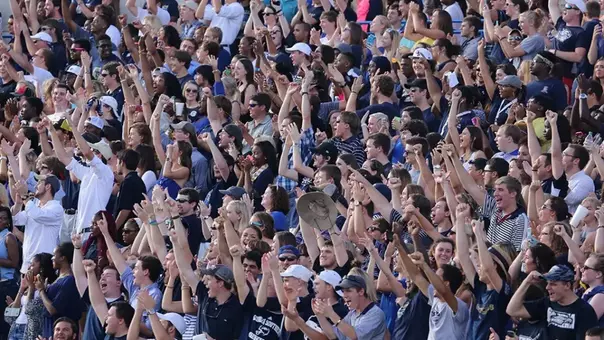
The biggest thing Eagle Nation can do is show up to games. We've got to give you the right experience, no doubt, but we have to make sure we have an unbelievable home schedule like we do this year. A lot of people are saying one of the best home schedules we've ever had. We have the first Power 4 team coming to Paulson and really good conference opponents coming to our house. Football is vitally important to us, and getting that bowl win was huge, but I know we're chasing more than that. I encourage everyone to purchase tickets, come to games, buy Georgia Southern gear and to be an active member of our fan community!
Women's basketball had an incredible year, winning the Sun Belt regular season title, and then men's basketball had five wins in five days down in Pensacola at the conference tournament to really draw some national attention to the program.
Swimming & diving, as well as track & field and men's tennis, continued to hit record marks, and I'm excited for where both Coach Adams with women's soccer and Coach McCaffrey with women's tennis are taking their programs this upcoming season. Then we've got softball and Coach Brown. They had a strong finish late, and I'm fired up for what she's going to do as we turn into next year.
Baseball is a sport that I think everyone is really upset about, including myself. I heard countless times from Coach Hennon in postgame interviews how he was taking the blame and realizing that we need to be better. We now have an unbelievable baseball facility we built together, and I mean that: together. That was Eagle Nation - donors, fan support, alumni support and institutional care of our entire team, led by Dr. Marrero. We need to make sure we put the baseball product together, so that's a huge focus going into this year.
Having Soren lead our rifle team and making it to the NCAA national championship for the second consecutive year was big. We won another SoCon title and we get to host the NCAA National Championship in Statesboro next March at The Hill. It's going to be an awesome event, and I can't wait to get more info out about that. It is a unique event as well, so I'm fired up to have that.
Our women's golf program came off a national championship bid from last year, and Mimi did a great job constructing a quality roster under unusual circumstances. I look forward to watching her team play at a high level this upcoming season after seeing the talent she has assembled.
And finally, Carter and the men's golf program once again made a regional and had some incredible tournament wins. Getting out there and making runs and representing Georgia Southern on the national stage is a huge accomplishment. Our golf program is very healthy, and that has a lot to do with our community. Our donors and fans support our golf program, and our coaches and staff really pull into it. I'm excited to see where we can get to as a men's golf program.
All in all, do we want more wins in 2026-2027? We all want more wins and more championships. But we do it the right way. One thing I'm really proud of is that we represented Georgia Southern. We also want to continue to chase wins the right way while making sure we pivot at any point in this college athletics landscape.
Q: Has there been any talk about dropping or adding sports at the varsity level?
CD: At Georgia Southern, we've had zero conversations about removing any of our sports. There are some sports we keep an eye on from an addition standpoint, but nothing is currently moving that direction. Right now, we've got to focus on what we have. We have a great mix of sports that are all supported financially to be competitive. We need to continue to raise our financial strength to continue to meet the competitive challenges while also making sure we communicate to Eagle Nation. Because once again, the people are our most vital asset. That includes the fanbase, the students, alumni, coaches and our staff. At the epicenter, the nucleus, are our student-athletes. All the young women and men who put that uniform on every year, who put a product out that they're loving their sport. You either like, love it, or live it. We want them to live their sport, be the conduit of growth and let them compete at the highest level. And we want to win as many as we can, so not only the teams and coaches have excitement, Eagle Nation does, as well.
Q: The Steverson Baseball Facility was the latest big facilities project and is close to being done. What's on the radar for the future?
CD: From a facilities standpoint, over the course of years I have been at Georgia Southern, formerly as the COO and now as the AD, we've been able to do a lot of projects and that's exciting. It's $100M+ worth of projects and the focus on those projects was also a lot of different timelines in college athletics. I know that sounds crazy to think about because five, four or three years ago doesn't sound like a long time. But the amount of change that has happened in college athletics over that time is hard to believe. We will continue to enhance our athletic facilities, but we also need to enhance other aspects of our competitive edge, which is our people piece.
So are we going to continue to do facilities? Yes. What does that look like? I think the next projects we look at, and there are a lot out there, include Paulson Stadium. Can we do a Bishop Field House enhancement? That's a big thing. That's probably our focus: the Bishop enhancement. I would love to do some things in the press box and suites. Is there an additional video board in play? All those pieces are things that we're looking at.
We'd love to do some things at softball. Exploring how we make that whole stadium feel more stadium-esque as it relates to a potential fan deck in the right-center field as we have at baseball, and maybe a nice entrance to the stadium. We did a lot of different things with soccer and track, but we continue to keep an eye on them. We're always looking at little tweaks and enhancements that we can do at the Jack and Ruth Ann Hill Convocation Center now that we've lived in the space.
Then you look at Hanner Fieldhouse, the tennis facility and Iron Works, which touches a lot of student-athletes. We have a lot of locker rooms inside Hanner, and we've enhanced a lot of them. You've seen those videos this year; you've seen those graphics. We're going to continue to look at Hanner and that whole area of Iron Works and tennis because that's a big corridor for us. We will also focus on some new things at baseball like the video board and the apron around the field that has seen its day.
Then anything that's fan-facing, we're always looking at making sure the fan and donor experience continues to elevate. I'm very big on that. Customer service is vital to us with our donors and fans being at our games. That's why some of these projects are awesome when you can enhance the student-athlete experience, the coaching experience for the student-athletes, while also enhancing the fan and donor experience.
Q: Finally, when you think about the overall 'state of the union' for Georgia Southern Athletics right now, what would you say to fans, donors and alumni about where the department is headed and why they should be optimistic about the future?
CD: First of all, I want to thank Eagle Nation for their constant and consistent care for Georgia Southern Athletics and Georgia Southern University as a whole. We need to continue to focus on trying to grow those touchpoints. We're beacons of information; all of our staff is, and so are our coaches. So if there's a person you need us to reach out to that we haven't, please reach out to us and let us know. We're going to consistently reach out, but we need everyone pulling the rope together and talking about things we have going on. That's really important.
You saw our Hall of Fame class, and the mix of that class, the various student-athletes that crushed their sports of play here at Georgia Southern that deserve and have earned their way into the Hall of Fame. We're about honoring because we are a school that is student-athlete-centric, coach-centric and also people-focused. The Hall of Fame class really shows that. Also, we're going to do the Hall of Fame every year. It's not going to be an every-other-year thing anymore. With us moving the event to the Jack and Ruth Ann Hill Convocation Center, it allows us to sell tickets to the public and to make it a grand event. That's really important to me to be able to honor more of our greats who have made Georgia Southern so special.
We must pull together and stay together. And when we have questions, and when we have concerns, we need to talk them out. I think it's really important that I'm always accessible. I think it's important that we look at this, because this is an ever-changing landscape and giving as much information as possible is going to be really important for me. And doing that in ways I enjoy, mostly face-to-face interaction. But I also know I'm going to do more written pieces and more videos, even though I love the human touch. I know we can do more, and we're going to do more. That goes back to the storytelling piece.
Then, as it relates to winning, we stay in a constant state of challenging our department with how we can win more. When we closed out the athletic season a few weeks ago at our last meeting, I challenged all our staff to ask how can we keep the vibe and the accelerated piece of making sure we impact our community, we impact our APEX program, we impact our GPAs, we impact our student-athlete experience, we impact making sure we graduate, we impact our ability to be in our facilities and enhance our facilities. But how do we also impact winning?
And we are winning in so many areas. But we want to win more. So we are putting the focus on making sure our coaches and our student-athletes know how we, Georgia Southern, our athletic department, our team of athletics support staff, and how we can help them win. And we want to tell our donors and fans how we can help Georgia Southern win more, compete and win championships. Because at the end of the day, we want to be a championship ecosystem that is people-focused but is focused on winning championships and having a process to achieve those goals.
Thanks for your time, and here's to a great 2026-27 Georgia Southern Athletics Year!
CD: Thank you, and Hail Southern! GATA