Southern Scribes: Celebrating Black History Month - Part 3
2/23/2024 10:00:00 AM | Sports Medicine, Strength and Conditioning, Sport Performance
The third in a four-part series
The article is the third of a four-part series looking at Black History Month through the eyes of the staff and student-athletes that make up the Georgia Southern Athletic Department.
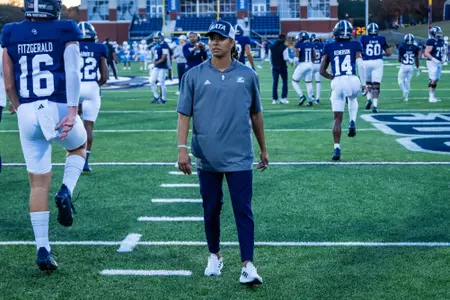
Taking a look at what Black History Month means to our sport performance staff.
STATESBORO - In this third week of February, we are continuing to explore perspectives around Georgia Southern Athletics by talking with some of our sports performance staff. This includes strength and conditioning as well as athletic training and makes up a huge part of the team behind the in-game success of our student-athletes.
While sports performance staff is often behind the scenes for fans, they make up much of the weekly, or even daily, interactions and training that student-athletes experience. As they are direct influences in the day-to-day lives of our Eagles, we wanted to get their perspective on what their position means to them, what advice they would give, and what Black History Month means to them.
Kaela Cornelius is an assistant athletic trainer working primarily with women's basketball. For Kaela, being in her position as an African American woman allows her the opportunity to make a difference for other people. She is able to be an inspiration to those around her in a way that she didn't get to experience as she was making her way into her career.
"To me, it means being a bit more of a role model," Kaela said. "Just because growing up, I didn't have many people that looked like me that were able to do the things that I am able to do. So, it's just nice to be able to be that inspiration in a way. Maybe for younger kids, or even college athletes, knowing that this is something that they can do and even being able to help them go past what I've been able to do."
When asked about what piece of advice she would offer to the next generation looking to be athletic trainers, Kaela wanted to highlight big goals. She says that the higher you aim, the higher you will be if you succeed, and the higher you will be if you fail.
"My biggest piece of advice is to aim as high as you can," Kaela stated. "A lot of times, people feel limited—especially with upbringing or having just educational limits. So, if being a doctor is what you want to do, aim for being a doctor. Even if you don't make it, you're still going to land
pretty high."
Black History Month, for Kaela, is about a celebration of all African Americans and the highlighting of things of the past that might be forgotten.
"Black History Month, to me, is just kind of a celebration of, you know, not only my history, but my ancestors, my family, all the African Americans that have come before me," she explained. "They have made huge contributions to the world that we live in now."
We asked Kaela if there was anyone specific whose accomplishments have inspired her, and she said there was not a singular person. She is inspired by the small sacrifices and efforts of everyone that add up to the biggest differences.
"As far as somebody that I think needs to be celebrated, I don't really have a singular person," she revealed. "I feel like the people who have made the biggest difference sometimes make little, tiny differences, but when you put it all together, it's what makes it a big difference."
The second staff member we wanted to highlight is Genevieve "G" Humphrey. She came to Georgia Southern in 2023 as an assistant strength & conditioning coach for football. G came to Southern with experience working with Olympic Sports (University of Pacific), Football (University of Tennessee), and the United States Air Force.
We asked G what it means to her to be an African American female in strength & conditioning. She chose to highlight the impact that she has been able to have in her position, on her athletes, and on those she has worked with.
"Understanding my role not only as an African American but specifically an African American woman has become more impactful throughout the years," she explained. "At first, I didn't see it as anything important, but specifically, African American men around me told me that my role as a strength coach is extremely crucial because it shows other African American women that it is possible to achieve the same accomplishments. As I have gotten farther along in my career, I have seen more of my impact, specifically from the young African American women I have worked with telling me they didn't even know it was possible to be a strength coach, let alone a female strength coach in a predominantly male sport like football."
Looking at the impact that she has already been able to have, we asked what piece of advice Humphrey had for anyone looking to be in her profession. She emphasized the importance of learning who you are in order to achieve success, no matter what career path you choose.
"Take the time to get to know and develop yourself," G insisted. "Then once you truly know yourself—your strengths, your weaknesses, how you navigate challenges—and you have taken the time to evolve and better yourself, OWN WHO YOU ARE. It is possible to be aware of others while continuing to be true to yourself. Never be anyone other than yourself."
For G, Black History Month is about more than just the accomplishments of the past. It is about continuing to celebrate and acknowledge the accomplishments of today and the things that will be done tomorrow, especially in light of the past.
"Over the years, I've only ever heard about the history of Black History Month," she revealed. "As I've grown through my adulthood, I see more of how we, as African Americans, exude excellence today. Yes, our history is important, especially when speaking to the history that was never told. But it's also SO important to highlight the excellence we've achieved in recent days, especially in spite of the history we have come from."
She continued on to explain that her father is someone whose accomplishments have inspired her in her journey, "In terms of accomplishments, I have to honor my father," G said. "He is Afro-Caribbean and immigrated to the States in the '80s. As I have pursued my career, I see so much of myself in him. When it comes to the moves I've made professionally, I hear my dad's voice saying, 'Go for it. Any opportunity that's in front of you, go for it, and go at full force.' I wouldn't be where I am today without my father continuing to tell me to keep moving forward."
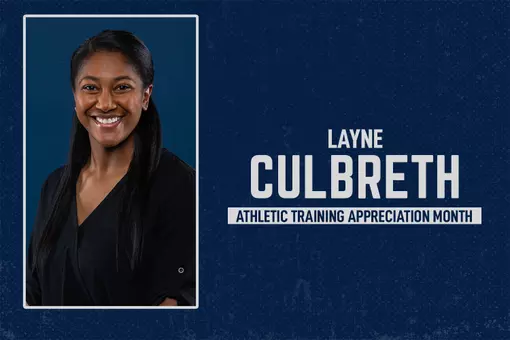
Our final staff member in this feature is Layne Culbreth. Layne is an athletic trainer who works primarily with softball. When she came to Georgia Southern, Layne was the only African American female on the athletic training staff. This has been part of the significance of her journey, being able to be an inspiration and see the growth of African American females in her profession.
"Being an African American in my position means everything to me," Layne started. "You don't see very many African American females as athletic trainers, and we are growing in the profession, but when I first started at Georgia Southern, I was proud to be the only female African American Athletic Trainer here. And I think that I've kind of paved the way for others to want to be athletic trainers. I've had a lot of students that have been African American females. They've kind of seen me in this role. So, being a good role model and being able to kind of bring people up with me into this profession is huge. It's comforting to know that we're making our mark and the ones that we have that are joining the profession and that are already in the
profession—we're getting more people interested in athletic training."
Being a part of the growth that she has seen of African Americans joining the athletic training community and being able to inspire those people herself has been extremely valuable for Layne. She also emphasized that there was someone who showed her this path when she was young, and that influenced her to be able to do the work that she is doing.
"You're seeing our faces on TV, in professional sports settings, and kind of all over, and I love being a part of that," she stated. "I love being African American. I love being a female and I love being an athletic trainer. Being able to kind of combine all three of those and influence others to be in that role is everything to me. I don't think I would have been where I am right now if it hadn't been for my athletic trainer in high school, who was a Black female athletic trainer. She inspired me to kind of go forth and do this. And she's someone that I look up to to this day. It really has been influential to me to have someone in that role, but then to also be that for people coming behind me as well."
When we asked Layne to give a piece of advice to those looking to be where she is now, she highlighted the importance of putting in the work to be the best that you can be and taking advantage of the opportunities you have.
"I would say just keep grinding," Layne said. "Keep trying to strive to be the best athletic trainer that you can be, and people will notice you. Having a good work ethic, working hard, being honest, and just striving for greatness all the time in everything that you do is going to push you ahead in this profession. And your athletes will see that, and they will trust you, and they will love you, and they will want to see you succeed. And it'll be easy for them to succeed. By having that role and that leadership opportunity, you kind of influence them to succeed in whatever they choose to do, even if it's not athletic training."
She proceeded to point out that asking questions and gathering information from those in the profession that you want to be in, regardless of their background, is important. And it is important to talk to people from a multitude of backgrounds to learn how to diversify yourself in order to succeed.
She proceeded to point out that asking questions and gathering information from those in the profession that you want to be in, regardless of their background, is important. And it is important to talk to people from a multitude of backgrounds to learn how to diversify yourself in order to succeed.
"Specifically, for those people that are interested in athletic training, I just encourage you to ask all the questions," Layne said. "Get all of the information that you can from African American females, from African American males, from really anyone in this profession—you can grow from anyone. I think, you know, being able to have Brandy [Clouse] as my boss as a female and see kind of what she's done as a mother and things like that, that has also led me to want to
strive to be that as well. So, I think having people who are from various backgrounds is going to influence you and make you more well-rounded. Working with athletes, you get athletes from all over. And so, making sure that you have a well-rounded background as far as your education will trickle down to what you're able to provide for your athletes. Asking as many questions as possible about cultures, other colleagues, and other professionals and figuring out where you fit in and how you can best influence the student-athletes that you work with is going to kind of put you on top."
In terms of the importance of Black History Month, Layne talked about how this has been a big part of her family since she was young.
"Black History Month is something that was very important in my family," Layne revealed. "Both of my parents were college-educated. They really emphasized Black History Month and making sure that we knew our heritage and where we came from growing up. And I think that in this position, I'm able to kind of share that with other people."
Layne went on to reiterate how she was inspired by her athletic trainer in high school but also point out the impact that her sister's career and accomplishments have had on her.
"I kind of mentioned her before, but one of my role models was my athletic trainer in high school," she started. "But one of my other role models is my sister, and just what she's been able to do as a female physician and an African American female physician, and just being a doctor and starting her own practice like that's huge for me. It inspires me every day to strive to be better. And I think that when you have family members who are pushing you or excelling, you kind of want to go along with them and kind of progress in your field as well. And I think I've done that. So, I think that having my family be in higher education and kind of extend that into professional settings, just shows how influential Black History Month is and how much we have grown and been able to kind of excel. No matter what circumstances we came through, just kind of seeing that growth throughout my family is huge for me."
These three women have really embraced the opportunity that they have to be an inspiration to others like them who are looking to succeed in their fields, but also the opportunity that they have every day to influence the lives of their student-athletes.
Addy Burrow is a fifth-year senior pursuing a Master's degree in professional communication. She is also an All-American on the Eagles' nationally ranked rifle team.
Sunday, September 27
Friday, September 25
Tuesday, September 22
Monday, September 21