Southern Staff Stories: Men’s Basketball Assistant Shawn Forrest
The 22-year coaching veteran returns to the bench after battling cancer.
Marc Gignac
10/8/2020
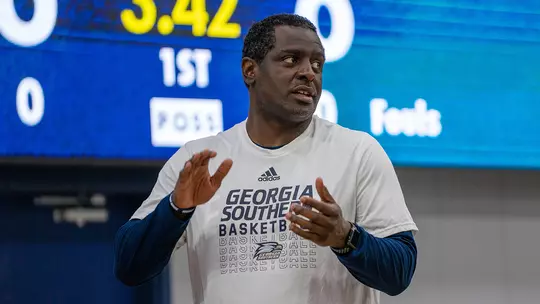
STATESBORO – Georgia Southern men’s basketball assistant coach Shawn Forrest will never forget the day he got the phone call.
He had gone in for an annual physical Oct. 5, 2019, and the call came the next day. The nurse told him the doctor needed to speak to him.
“He got on the line and said you need to come back in because your PSA levels are high,” recalls Forrest. “I was like, ‘What is that?’ He said, ‘That's what we check for prostate cancer.’”
Truth be told, Forrest’s annual check-ups had become less and less annual as his college basketball coaching career took off and moved him all over the country with the last stop being in Dallas, Texas, at SMU. From the season to recruiting to summer workouts to preseason workouts, it is easy for coaches to get swept up in the hustle and bustle of the business. Plus, with round-the-clock access to an athletic trainer and team doctor, preventive medicine takes a back seat.
“I just hadn't had a physical in like seven years,” says Forrest. “As a basketball coach, you see your trainer every day, and it's kind of one of the perks of the job that you have a team doctor and an athletic trainer affiliated with the team. So, if you feel bad, like stuffed up or whatever, you tell them, they get you a prescription, and you feel better.”
Forrest had left his job at SMU in the summer and had more free time on his hands in September than he had in the last 20-plus years. It was his wife, Renea, who lovingly nagged him, for lack of a better term, to get an annual check-up.
“She went to lunch with a couple of her girlfriends, and they had talked about their husbands getting physicals,” remembers Forrest. “She came home and said, ‘You need to go get a physical.’ She knows how much I hate the doctor, but she kept saying it and finally, I was like, ‘OK, I'll go,’ basically so she'd leave me alone.”
Once he did surgery, he found it was moving toward my bladder and he said, ‘In another six or seven months, I don't know if I could have done anything for you.' If I don't go to the doctor when I did, I would have just rolled through another basketball season.
Forrest went in for his appointment, and the doctor told him everything looked good. He said they would call him if anything came up on his blood test. The call came the next day, and it was a shock because Forrest felt fine.
“The first time you hear cancer, I think it's human nature that you think death, so I was like, ‘Am I going to die?’” says Forrest. “The hardest thing is telling my wife and kids because that's the first thing they thought when I told them I had cancer.”
Forrest went in for surgery two days before Christmas, and the doctor surmised that he had cancer for 19 months before it was discovered.
“Once he did surgery, he found it was moving toward my bladder and he said, ‘In another six or seven months, I don't know if I could have done anything for you,’” says Forrest. “If I don't go to the doctor when I did, I would have just rolled through another basketball season.”
Forrest was two-and-a-half months removed from the surgery when the COVID-19 pandemic shutdown began. A guy who was accustomed to spending his March with 16 to 18-hour days in the office preparing for tournament basketball was now recovering from surgery and sheltered in place with Renea and two daughters, Aaliyah and Alyssa.
“You just say yes a lot,” Forrest says with a laugh. “The biggest thing we had to get adjusted to was being in the house for as long as you had to be in the house. We enjoy being around each other, but I'm glad they all have TVs in their room so everybody could go watch what they want watch.”
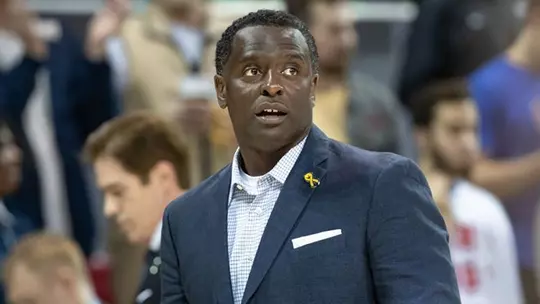
Forrest knew he wanted to get back into coaching, but the pandemic put the traditional annual movement in the college ranks in doubt. One thing was certain; he needed to recover from surgery and get the all-clear from his doctor first.
“It was all based on health,” says Forrest. “I had to come back healthy, but then with the pandemic, you're thinking, there might not be as much job movement and you have to find the right opportunity, whether it was college or high school or whatever.”
Forrest and Georgia Southern head coach Brian Burg had developed a friendship through their years in the business. Forrest had told Burg, an assistant at Texas Tech at the time, about his cancer diagnosis, and Burg checked in on Forrest consistently to see how he was doing and to offer support. On March 25, Forrest went in for some tests and got great news.
“I went in and took the test, and he said, ‘You're cancer free,’” says Forrest.
One of the many people Forrest called that day was Burg, and Burg hinted that there may be more good news coming. He was about to be named the head basketball coach at Georgia Southern. The school made the official announcement March 29.
“I talked to Coach Burg that day, and we celebrated and then three days later he gets the job here,” recalls Forrest. “We had always talked about working with each other, but for it to actually happen? I mean in this business, people tell you a lot of things, but it says a lot about his character for him to keep his word.”
Forrest packed up the car and drove to Statesboro in July, while Renea, Aaliyah and Alyssa stayed in Dallas. Aaliyah is a junior in high school and being recruited to play basketball at a number of Power-5 schools, and with Georgia Southern being his sixth stop on the coaching carousel, there was no need to supplant the family yet again, especially now that the girls are older. Forrest’s oldest daughter, Abri, graduated from Western Kentucky and is an athletics academic coordinator at Lindenwood University, located just outside St. Louis.
In Statesboro, Forrest went from chaos to solitude - from a house full of women taking care of him after surgery to living alone 940 miles away.
“It's kind of like when I played pro ball overseas, but the biggest thing now is technology because I get to Facetime them all the time,” he says “It's not the same as being there, but you actually get to see them every day and talk to them. You try to stay busy and then it makes it more precious when you get to see them. We take for granted being able to see our families every day so now you appreciate it a lot more.”
Now healthy and back doing what he loves, Forrest is focused on building relationships at Georgia Southern, especially with the 18 student-athletes on the Eagle roster.
“I'm a big relationship guy, and the reason I got into coaching is to affect lives,” says Forrest. “It's a 40 to 50-year relationship and bigger than basketball for me. Once they leave here, I'm always going to be a part of their life. They could care less how much you know until they know how much you care. Once they know that coach cares about me and wants to help me, they open up.”