Memories of Georgia Southern Football Past
11/8/2013 3:35:00 PM | Football
From the desk of Max Lockwood, Director of Alumni Affairs
From the desk of Max Lockwood, Director of Alumni Affairs (Georgia Southern College)
Football has emerged as American's sport for today's super spectator. It enjoys a pomp and glamour that has never before been bestowed on a professional or amateur sport. Spectators gather in the greatest monuments to man's engineering and no one – from Sun City retirement cottages to snowbanked South Dakota farms can remain oblivious to the glorious world of football.
The weekend classics of 260-pound giants echo from sea to shining sea across the land signaling yet another battle in the endless war of America's greatest sport.
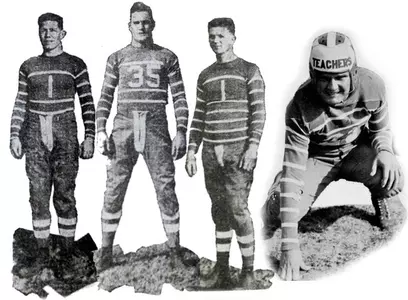
But there was a day – a day when the battles were fought on cow pastures, the troops were 135-pound "midgets" and the glory existed only in the minds of those who struggled to keep it alive. Nevertheless, what it was was football and Georgia Southern College was part of it.
The stories of those who lived it best describe the era of GSC Football and in their reflections rest the keys of unlocking the door to the past.
It all actually began back in the early twenties, but the days of football at Georgia Southern will best be remembered during the era of B.L. "Crook" Smith, the "Granddaddy of GSC Athletics." He came to Georgia Southern in 1929 after finishing his own college career at Mercer. He was not only the football coach, but the coach of everything else as well. Although his best teams were on the basketball court, some of his fondest memories were inscribed on the football field.
"Football was the most popular sport we had at Georgia Southern," said Smith. "The town's people supported it fairly… more than any other sport. We really got support from the people in the surrounding towns like Claxton, Metter, and many of those.
"We had our own little conference back in those days. South Georgia, Norman Park, Brewton Parker, Abraham Baldwin, Cochran, Barnesville, Normal, but we also played some of the bigger schools like Tampa, Erksine, Newberry and Miami. We would play anybody."
Money was scarce for athletic programs in those days and the word "scholarship" was almost non-existent. About as close as a young football hopeful could get to a scholarship was a job "firing boilers around town" in his spare time.
"Half my boys had never even had on a football uniform until they got here," said Smith.
George Thrift was one of Smith's first players in 1929. He was small, but according to the coach, "you couldn't burn him, break him, bend him or stretch him."
Thrift recalls one of his memorable experiences was when the team was to play a game in Savannah.
"We left Statesboro at 7 a.m. on the train," he remembered. "They had some trouble with flooding along the way and by the time we got to Savannah, the sun was just setting over the horizon. Since they had no lights, we had to cancel the game and just turn around and head home."
The playing fields were often times no more than cow pastures and often times not even that good.
"I can remember going out and playing on fields where cows grazed," recalled A.A. "Gus" Baird, former quarterback under Smith. "We would go out before the game, rope off the cows, and then clean up the field so we could play.
"I remember one place we played at Appalachian State Teacher's College up in Boone, N.C. They carved their field out of the side of a mountain and before the game, they ran a road scraper over the red clay to smooth it out. I fell once on that field and it scrapped all the skin off my face and leg," Baird commented.
The total record for GSC football teams under Smith was just about even, perhaps losing more than they won. But GSC did play some of the big boys of that era in college football, as a matter of fact, they tackled three of them in one week.
"I can recall playing three games in eight days," said Tom Brantley, a tackle on the 1939 team. "We played Miami on Friday night, Tampa on Tuesday night and Stetson the next Friday night.
"We were the first team to ever play on the Orange Bowl field in Miami in their home opener," commented Brantley. (Note at end says they were pouring concrete at the stadium on the day they played).
Earl Riggs and Jake Hines were two of the most outstanding players under Smith during his coaching days at GSC.
"Earl could have made anybody's football team. He never lost a minute of practice and was never hurt or injured," said Smith.
"Jake Hines was an awfully good player. He was a halfback and I'll never forget the time he broke into the open around the end and as he passed in front of the bench, he yelled, 'watch me carry the mail, coach.' He was waving the ball around as he said that and all of a sudden he dropped it. We never let him forget that."
Then the war came in 1941 and the boys were called upon to fight in another battle. Football at Georgia Southern was over.
Football has emerged as American's sport for today's super spectator. It enjoys a pomp and glamour that has never before been bestowed on a professional or amateur sport. Spectators gather in the greatest monuments to man's engineering and no one – from Sun City retirement cottages to snowbanked South Dakota farms can remain oblivious to the glorious world of football.
The weekend classics of 260-pound giants echo from sea to shining sea across the land signaling yet another battle in the endless war of America's greatest sport.
But there was a day – a day when the battles were fought on cow pastures, the troops were 135-pound "midgets" and the glory existed only in the minds of those who struggled to keep it alive. Nevertheless, what it was was football and Georgia Southern College was part of it.
The stories of those who lived it best describe the era of GSC Football and in their reflections rest the keys of unlocking the door to the past.
It all actually began back in the early twenties, but the days of football at Georgia Southern will best be remembered during the era of B.L. "Crook" Smith, the "Granddaddy of GSC Athletics." He came to Georgia Southern in 1929 after finishing his own college career at Mercer. He was not only the football coach, but the coach of everything else as well. Although his best teams were on the basketball court, some of his fondest memories were inscribed on the football field.
"Football was the most popular sport we had at Georgia Southern," said Smith. "The town's people supported it fairly… more than any other sport. We really got support from the people in the surrounding towns like Claxton, Metter, and many of those.
"We had our own little conference back in those days. South Georgia, Norman Park, Brewton Parker, Abraham Baldwin, Cochran, Barnesville, Normal, but we also played some of the bigger schools like Tampa, Erksine, Newberry and Miami. We would play anybody."
Money was scarce for athletic programs in those days and the word "scholarship" was almost non-existent. About as close as a young football hopeful could get to a scholarship was a job "firing boilers around town" in his spare time.
"Half my boys had never even had on a football uniform until they got here," said Smith.
George Thrift was one of Smith's first players in 1929. He was small, but according to the coach, "you couldn't burn him, break him, bend him or stretch him."
Thrift recalls one of his memorable experiences was when the team was to play a game in Savannah.
"We left Statesboro at 7 a.m. on the train," he remembered. "They had some trouble with flooding along the way and by the time we got to Savannah, the sun was just setting over the horizon. Since they had no lights, we had to cancel the game and just turn around and head home."
The playing fields were often times no more than cow pastures and often times not even that good.
"I can remember going out and playing on fields where cows grazed," recalled A.A. "Gus" Baird, former quarterback under Smith. "We would go out before the game, rope off the cows, and then clean up the field so we could play.
"I remember one place we played at Appalachian State Teacher's College up in Boone, N.C. They carved their field out of the side of a mountain and before the game, they ran a road scraper over the red clay to smooth it out. I fell once on that field and it scrapped all the skin off my face and leg," Baird commented.
The total record for GSC football teams under Smith was just about even, perhaps losing more than they won. But GSC did play some of the big boys of that era in college football, as a matter of fact, they tackled three of them in one week.
"I can recall playing three games in eight days," said Tom Brantley, a tackle on the 1939 team. "We played Miami on Friday night, Tampa on Tuesday night and Stetson the next Friday night.
"We were the first team to ever play on the Orange Bowl field in Miami in their home opener," commented Brantley. (Note at end says they were pouring concrete at the stadium on the day they played).
Earl Riggs and Jake Hines were two of the most outstanding players under Smith during his coaching days at GSC.
"Earl could have made anybody's football team. He never lost a minute of practice and was never hurt or injured," said Smith.
"Jake Hines was an awfully good player. He was a halfback and I'll never forget the time he broke into the open around the end and as he passed in front of the bench, he yelled, 'watch me carry the mail, coach.' He was waving the ball around as he said that and all of a sudden he dropped it. We never let him forget that."
Then the war came in 1941 and the boys were called upon to fight in another battle. Football at Georgia Southern was over.

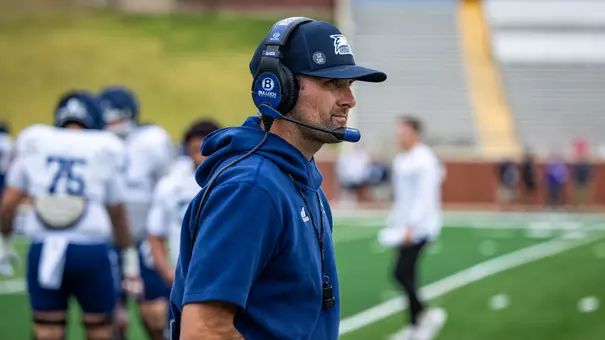
Andy Harris
Friday, June 12
Hall of Fame Phone Calls
Tuesday, June 09
Your Seat, Your Story: Darryl Hopkins
Thursday, June 04
Countdown to Kickoff: Erk Russell Fund Message
Thursday, May 28