SOUTHERN STAFF STORIES: Sean McCaffrey, Anita Howard & COVID-19
The pandemic struck close to home for Georgia Southern athletics as a pair of head coaches battled the virus this year
11/4/2020
STATESBORO - The 2020 calendar year has been dominated by the COVID-19 pandemic and how it has affected nearly every facet of life for billions of people across the globe.
The Georgia Southern athletics department was not alone in feeling the effects of the virus, from the NCAA shutting down of spring sports midway through the season in March, to the altered practice and competition schedules that all of the Fall sports are currently experiencing.
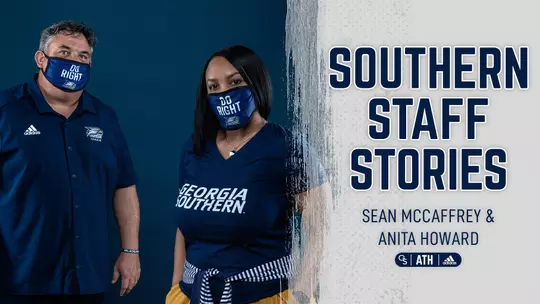
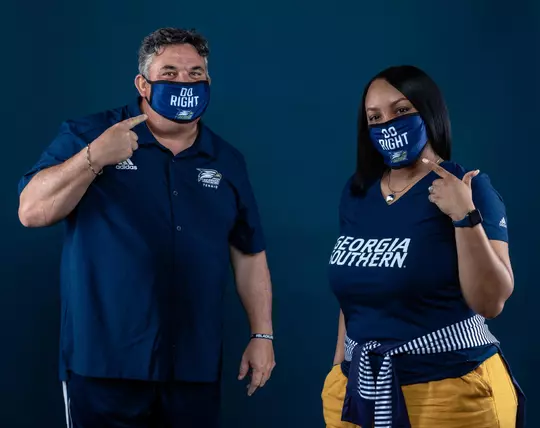
For a pair of Georgia Southern head coaches, however, COVID-19 hit a little harder than many have experienced. Head Women's Tennis Coach Sean McCaffrey tested positive in early September, while Head Women's Basketball Coach Anita Howard was positive in late July. As with most who have felt its effects, the individual battles of both with the virus differed.
Coach McCaffrey recalls that he started feeling its effects in early September. "I started experiencing some pain and aches in my joints, and felt lethargic," Coach McCaffrey said. "Over the next couple of days, I removed myself from the team because I felt I had symptoms. I started quarantine and went to get tested. But by the fourth or fifth day, I was certain I had it. I spent the better part of two or three days in bed, with lots of nausea. I felt like I was going about a mile an hour, just slow.
"Things got really bad and my pulse-oxygen levels got low," Coach McCaffrey said. "I was becoming incoherent, and had a definite brain fog. My sport supervisor Brandy [Clouse] spoke to my wife for a little while, and after one more conversation with my doctor, they decided that I should go to the hospital."
How long it takes for someone who has tested positive to recover while hospitalized has not been an exact science throughout the pandemic. Some are able to go home after only a day or two, while some spend weeks. Coach McCaffrey ended up spending eight days in the hospital, and had one particularly tough moment while there.
"I could hear the hospital staff talking," Coach McCaffrey said. "I don't think they knew if I was asleep, or coherent, but they were having a conversation about whether or not I was going to make it. There was some doubt in their mind. At that time, I went into a bad place in my head. And they shared that info with my wife. There's no visitation, and at this time my wife and youngest daughter were home, quarantining. I only knew what I was hearing from the doctors and the staff. So I knew it was mostly on me to try and beat this."
Breathing exercises were key into helping Coach McCaffrey start to improve the pulse-oxygen levels that had been so critical early on. And also laying on his stomach. "I was told that helps one breathe and opens up the lungs," Coach McCaffrey said. "So I would spend hours on my stomach. I think one of the things that impressed the staff, that I was able to make it competitive. And with some of these therapies, I started feeling stronger and getting better. I kept asking, 'what do I need to do to get home?'"
I could hear the hospital staff talking. I don't think they knew if I was asleep, or coherent, but they were having a conversation about or not I was going to make it. There was some doubt in their mind.
A month and a half earlier, Coach Anita Howard was at home when she first felt the full effects of COVID-19 hit her. "I was out doing a community service event, and it was really hot that day," Coach Howard said. "I was going to stay late and help, but I was so tired, I wanted to go home and hydrate. When I unlocked the door, my body was hurting. I didn't think of COVID at the time, I was thinking of everything else. When I went into the bedroom, I just fell into the bed. And for me to come from straight outside and lay down - I would never do that. My husband knew something was wrong."
Coach Howard has asthma, and it's a condition she's dealt with all of her life. "The following day, after going through that all night, I had problems breathing," Coach Howard said. "I just thought I had overdid it [the day before]. I didn't put two and two together, I thought my asthma was acting up. But there was a pressure on my chest that was quite different than asthma. After using my rescue inhaler it usually subsides. But when that didn't work, it spooked me. I couldn't catch my breath. My husband and son were outside, looking at something in the car. I opened the door and just shook my head like something's not right."
A trip to the ER followed, and even that was unsettling with the protocols involved. "It got more scary, because my husband is always with me in times of need. When we pulled up to the hospital, they didn't let him go back there. So that sent me into even more shock, just having to experience that by myself. They took me to a room, hooked me up to an IV and put me on oxygen."
Coach Howard spent the night in the hospital, and had a choice to go home or go to another facility. "The next day, I was feeling about 50%," Coach Howard said. "My mom wanted me to go to Augusta. But me, being 'Strong Anita', felt I could handle it at home since I had felt a little better. And I did get through the next day at home. Felt good in the morning, so I thought 'Shoot, I beat this thing!'
"I started cleaning up around the house, and after maybe an hour, my body crashed again," Coach Howard said. "I knew we couldn't make it to the hospital so my son called an ambulance. I am so grateful for the EMT, Leane Hodges, for what she did in my home that night. I said that I didn't want to go back to the hospital, so she stayed the rest of the night. Went above and beyond the call of duty. Gave me saline, oxygen and even gave me a little cross. We talked about our religion, and she was able to calm me down while she was doing her job."
That night was the turning point for Coach Howard, as luckily she was able to recover at home without a need to return to the hospital. It still didn't make the experience any less scary. "With asthma as a pre-existing condition, that's what COVID-19 really targeted for me," Coach Howard said. "I had all the symptoms - the lost of taste and smell, the aches. It feels like you were in a car accident, except you weren't in the car, you got hit by the car. You just can't get comfortable no matter what you do."
Waited to post until I was better... and today I'm thankful! ????
— Anita P. Howard (@CoachAGHoward) July 25, 2020
Thanks to my family, friends, staff, WOC, Brandy, Layne, EMT Leane Hodges, and ALL who helped and checked on me. God is good! #COVID19 #WearAMask ?? pic.twitter.com/4tJ8KohvZv
So when Coach Howard learned that her colleague was in the hospital with his own battle with COVID, she reached out to him via text with some thoughts and a small bit of advice.
"I told him that one of the things I did was that I researched too much," Coach Howard said. "I read about every worst case scenario, and that just made my situation worse. So my husband and I tried to do fun things, like watching Netflix together, to keep your mind off of it. If you watch something lighthearted, it helps you keep your spirits up and fight it off. I know it helped me get through those isolation days."
Coach McCaffrey was appreciative of all of his friends and family who did reach out to him through his hospitalization and subsequent isolation. And especially the texts and videos the women's tennis team sent him.
"They gave me the motivation to keep going," Coach McCaffrey said. “The videos from the team, the notes from friends and family, it all helped. After that one time I heard the doctors talking, it was very difficult to deal with. I knew I had things to fight for, and my team helped remind me of that.”
Both Coach Howard and Coach McCaffrey talk now about being part of a growing group of people worldwide now known as COVID-19 "Long Haulers," or people dealing with the symptoms long after recovering from the virus.
"Sometimes you can't help it," Coach McCaffrey said. "The nausea comes back, the aches, the breathing issues. All of those things I've experienced for weeks after I was released. I know I'm going to have to deal with it for months. It seems like there are some days where I take a step forward, but then the next day it takes three steps back. I just have to find a way to be patient and allow myself to rest and recover."
Coach Howard has also had the same experience, exacerbated by her asthma. "I still have long-term effects with my lungs," Coach Howard said. "Sometimes it's just hard to breathe, and you can't explain it. It's that pressure on my chest, that my rescue inhaler can't lift up. I just have to take medicine, let it subside, and sit forward for a little bit. It's scary for an asthmatic because the inhaler is something soothing that you know can help you right away. But you have to just relax yourself."
The experience for both coaches also put into perspective just what life within the pandemic currently entails. And both have a message for Eagle Nation not to discount or underestimate what all COVID-19 involves.
"I feel it's my obligation," Coach McCaffrey said. "To tell my team to be so vigilant with everything they do. Watching all of these other teams have to cancel games and matches, and I know sometimes they can't help it. But this thing was real. To me, and to my family. It was as real as everything I've ever experienced. It kept me away from my team for one full month. I am thankful for Jared [Benko] and Brandy for their support during my recovery, and especially to my assistant, Lena Lutzeier, and her extremely competent leadership of the squad during that time.”
"I know a lot of people, asthmatics like me, where it's hard to talk while wearing a mask," Coach Howard said. "I'm used to it now, and we've all been wearing masks for months. But the wearing of masks, the washing of hands, are simple gestures we need to take seriously. We need to protect each other and our neighbors. It's common courtesy."