The Anti-Algorithm: Why Erk Russell’s Dirt-Road Brilliance Would Still Win in 2026
Katy Baker
7/23/2026
I’m the only college football coach in America with a jacuzzi in my office—it just doesn't work.- Erk Russell
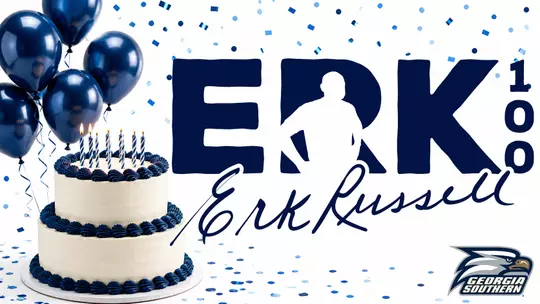
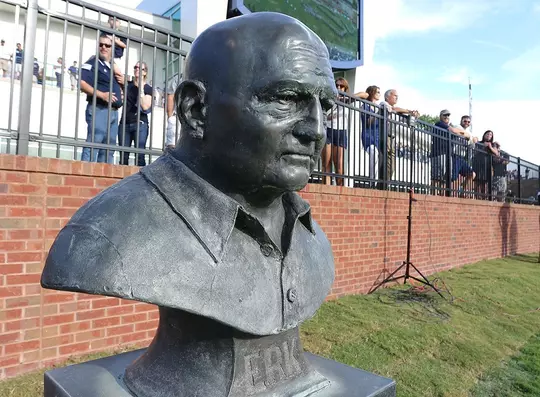
Today, Georgia Southern celebrates the 100th birthday of one of the most influential figures in college football history. Erskine "Erk" Russell, the architect of Georgia Southern Football, transformed a program that had been dormant for four decades into a national powerhouse and built a culture whose impact continues to define Eagle Nation.
Named the program's first head coach in 1981, Russell led the Eagles from 1982-89, compiling an extraordinary 83-22-1 record (.788 winning percentage). In just eight seasons, he guided Georgia Southern to five NCAA Division I-AA Playoff appearances, three national championships (1985, 1986 and 1989), and a runner-up finish in 1988. His 1989 squad became the first 15-0 team in Division I football history, capping one of the greatest seasons the sport has ever seen. Before arriving in Statesboro, Russell spent 17 seasons as defensive coordinator at Georgia, where his legendary "Junkyard Dogs" defenses helped lead the Bulldogs to the 1980 national championship. A 19-time Coach of the Year honoree, 1989 Eddie Robinson Award winner, AFCA Division I-AA Coach of the Year, Georgia Sports Hall of Fame inductee and USA Today Coach of the Decade for the 1980s, Russell's legacy extends far beyond wins and championships. His passion, authenticity and timeless motto of "GATA" forged the foundation of Georgia Southern Football and inspired generations of Eagles to "Do Right"—a legacy that continues to shape the program nearly four decades after his retirement.
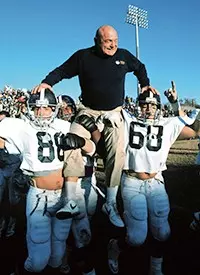
As college football hurtles through 2026—an era ruled by transfer portal bidding wars, Name, Image, and Likeness (NIL) collectives, and algorithmic personal branding—it is almost impossible to imagine that a man like Erk Russell could still matter so much.
He wasn’t a showman, yet the stories still shared make you think otherwise. He didn't have a communications team or a crisis-management PR firm; he had a megaphone, a dark navy blazer, and a beautiful bald head that he occasionally rammed into his players' helmets until blood trickled down his forehead. It was unfiltered, terrifying, and, by today’s HR standards, an absolute nightmare.
Yet, as Eagle Nation celebrates Coach Russell’s 100th birthday, we find ourselves suffocating under filtered perfection. His centennial is the ultimate reminder of an overlooked truth about leadership: People don't follow polished protocols. They follow leaders who aren't afraid to bleed with them. Erk Russell shows why that truth still matters.
Rather than simply revisiting well-worn lore, this look at how Erk would navigate today’s hyper-managed landscape reveals a clear consensus among those who knew him best: He wouldn't just survive; he would thrive. And that is the point.
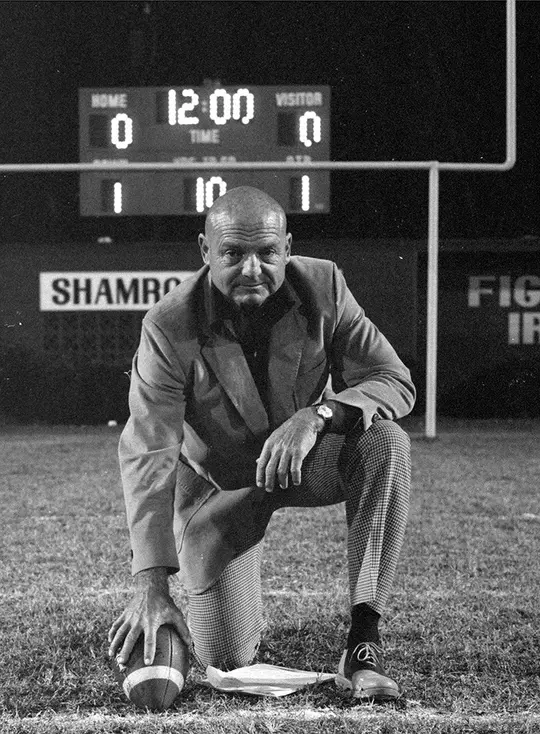
The Social Media Era vs. The Rattlesnake Standard
Some of today’s players live behind screens, managing personal brands and quantifying their self-worth in social media followers. Drop Erk Russell into a locker room full of smartphones, and he wouldn't flinch.
“He’s old-school on a lot of that stuff, but he’d probably say, ‘I don't care how many followers you have; I want to know how many teammates trust you,’” says Terry Harvin, Deputy Athletics Director of Development and punter on Southern's 1989 national championship team.
Erk understood viral visual storytelling decades before TikTok existed. He didn't need a social media strategy when he famously brought a live rattlesnake into the locker room to illustrate the lethal danger of drugs—pouring flour over the floor to represent cocaine before unleashing the reptile to send players scrambling through the doors.
A coach whose daily life revolves around genuine, unfiltered impact wouldn't be fazed by social media or cameras. However, the current challenge that would cause Coach Russell significant concern is the transfer portal.
“I think he would have heartburn with that because the idea that you just come and go—I don't think he would like that,” Harvin admits. “He’d rather have 85 Eagles who were all-in than 85 mercenaries.”
Roger Inman, Erk’s longtime colleague and Jack-of-all-trades, echoes the sentiment: “Erk would never have gotten into bidding wars for players. His stance was simple: If you don’t want to be here, I don’t want you here.”
Dissolving Ego in an Era of "Me First"
In a sports landscape where multi-million-dollar facility upgrades are used to entice recruits, Erk’s genius was in doing the exact opposite: dissolving ego and weaponizing humble beginnings.
When Erk arrived in Statesboro in 1981 to resurrect a football program that had been dormant since WWII, there was nothing: no stadium, no fancy weight room, and no polished offices.
Georgia Southern Hall of Famer Frank Hook remembers the bleak realities that would make today’s high-profile coaches turn and run. “Coaches probably would not come to Georgia Southern today if we told them their office was going to be a single-wide mobile home that isn't balanced and wiggles if you move.”
Instead of complaining, Erk bragged about it. He would tell callers on his landline, “I’m the only college football coach in America with a jacuzzi in my office—it just doesn't work.” When recruits asked to see the weight room—which at the time consisted of rusty, beat-up weight plates donated by a local welder—Erk would pat his pockets, pretend he forgot his keys, and march them out to show them “the prettiest little stadium in America” before they could ask twice.
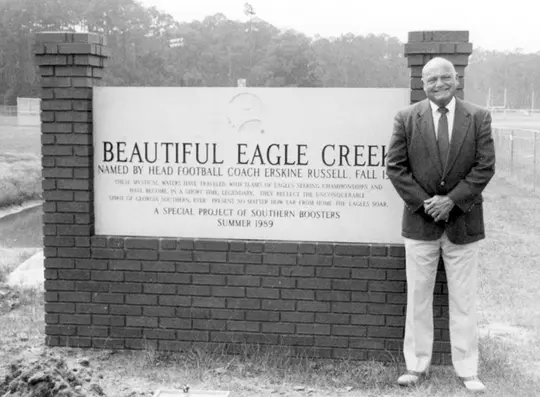
He took an ordinary drainage ditch filled with tin cans and transformed it into "Beautiful Eagle Creek," creating a mythos so powerful that players still get baptized in it today. He didn't buy loyalty; he built an elite brotherhood out of overlooked players who would perform far beyond their perceived limits simply because Erk made them believe they could.
Former Eagles quarterback, College Football Hall of Famer, and current Senior Associate AD for Administration at Southern, Tracy Ham, shared how Erk molded his players to be the best version of themselves on the field. “I just think he knew how to make players understand that if you're good enough, you're good enough. If you're not, work on this, and you'll be good enough.”
Ham also recalled pre-game sideline chats with Erk that helped him maintain composure and focus. “It would just be him and me, and he would say, ‘Hey, Tracy, go do your thing,’ and at first I wasn’t sure what he meant by that.” This was Coach Russell’s way of saying: go out and play and don’t worry about making mistakes. “He freed you up to be the best version of you that you could be,” Ham added. “And I just think that was one of his innate abilities as a coach and as a communicator.”
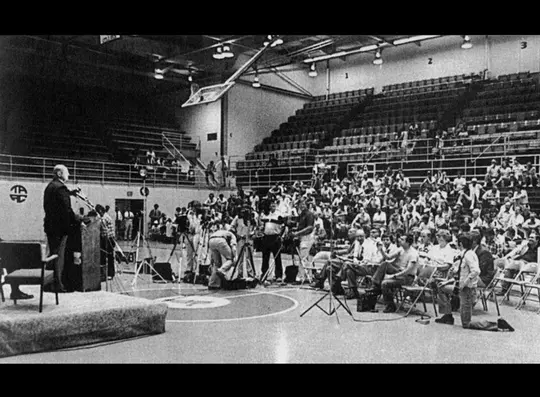
The "Do Right" Playbook for Modern Leadership
Stripped of 1980s nostalgia, Erk Russell’s management style was a masterclass in clear expectations and transparent, personalized leadership—and that is why it still resonates.
While modern coaches and corporate executives hide behind 50-page handbooks and vague buzzwords, Erk kept his operational standard down to two simple words: “Do Right.”
“He kept things simple, keeping the main thing the main thing,” Harvin reflects. “It’s a culture we use every day in life. You do right by your employees, you do right by your university, and you do right by your community. His legacy is that mentality: Anybody can do almost anything, just one more time.”
That ability to cut through the noise with plain-spoken clarity was legendary. When Hook once drafted a formal, flowery letter on university letterhead inviting former Georgia star running back Herschel Walker, whom Erk coached in Athens, to campus, Erk looked at it, grabbed his trusty black Bic pen, and scribbled a note on a yellow legal pad instead:
“Dear Herschel.
We play East Tennessee State in November.
Get yourself down here.
We’ll have a Coke after the game and open a pack of crackers.
Call me.
– Erk”
One More Time
As Georgia Southern dedicates its 2026 football season to Coach Russell's 100th birthday, his memory isn't defined by wins or X’s and O’s. It lives on in the culture he left behind.
We don't just miss Erk because he won three national championships on dirt roads and yellow school buses. We miss him because he represents an authentic, uncompromising antidote to an over-engineered world.
He proved that you don't need algorithms, massive NIL bidding wars, or corporate optics to achieve greatness. Erk Russell’s real legacy is simpler: clear standards, authentic personal connection, and the willingness to give everything you have—just one more time.
Katy Baker is an M.F.A. writing candidate at the Savannah College of Art and Design. She is currently the assistant director of alumni events at SCAD but has previously worked as an assistant sports information director at Florida State University. This is her first feature for Georgia Southern as part of an internship with the athletics communications department.